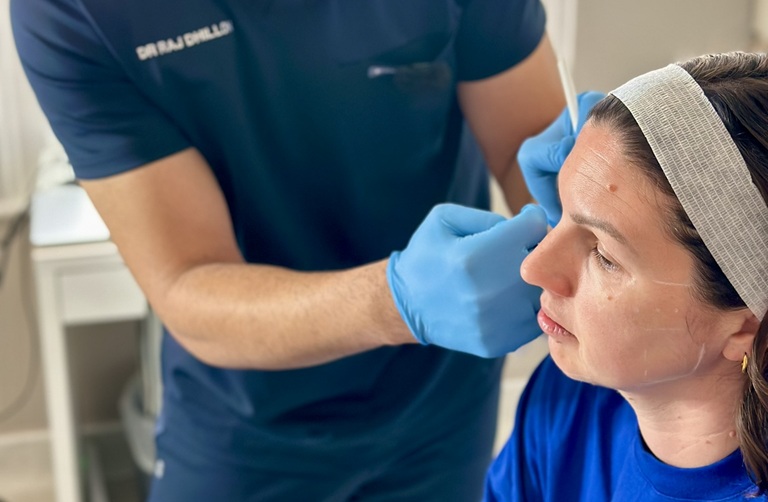
What Does Salicylic Acid Do for Your Skin? A Doctor’s Guide to Spots, Blackheads & Pores – by Dr Raj Dhillon
If you’ve ever looked into skincare for spots, blackheads or oily skin, you’ve probably come across salicylic acid. It’s found in everything from facial cleansers and serums to exfoliating pads and professional skincare treatments.
But what does salicylic acid actually do, and is it something everyone should be using?
Although it’s best known for helping blemish-prone skin, salicylic acid has several benefits. It can help keep pores clear, reduce blackheads and improve uneven skin texture. However, not all spots or visible pores are the same, and understanding what you’re trying to treat is just as important as choosing the right ingredient.
For example, those tiny dark dots on your nose might not be blackheads at all, while a deep, painful spot beneath the skin needs a completely different approach.
What Is Salicylic Acid and How Does It Work?
Salicylic acid is a type of exfoliating acid known as a beta hydroxy acid (BHA). Rather than relying on scrubs to remove dead skin cells, it helps loosen and remove them more gently through chemical exfoliation.
What makes salicylic acid particularly useful is that it can work within the oily environment of your pores, helping to clear the build-up that can lead to blackheads and certain types of spots.
Our skin naturally produces oil, called sebum, which helps keep it moisturised and protected. However, when excess oil mixes with dead skin cells, it can collect inside pores and cause blockages.
Salicylic acid helps prevent this build-up, keeping pores clearer and making the skin look and feel smoother.
It also has anti-inflammatory properties, which may help calm some of the redness associated with mild blemishes.
Blackheads, Pimples, Cystic Spots and Sebaceous Filaments: What’s the Difference?
Not every spot or dark dot on your face is the same. Although they can look similar, understanding the differences can help you choose skincare that’s more likely to work.
Blackheads
Blackheads form when oil and dead skin cells collect inside a pore, but the opening remains exposed to the air.
The material inside reacts with oxygen and darkens, creating the familiar black appearance. Despite what many people believe, blackheads aren’t caused by dirt or poor hygiene.
They’re particularly common on the nose, chin and forehead.
Salicylic acid can be helpful because it loosens the material responsible for the blockage. With regular use, blackheads may become less noticeable, and fewer new ones may develop.
Sebaceous Filaments
Those tiny grey, yellowish or slightly brown dots across your nose aren’t necessarily blackheads. They may actually be sebaceous filaments.
Sebaceous filaments are completely normal. They help move your skin’s natural oils to the surface, keeping it moisturised and protected.
They’re usually smaller and more evenly distributed than blackheads and are particularly noticeable around the nose.
Salicylic acid may make them appear less prominent by reducing excess oil and build-up, but sebaceous filaments aren’t something that needs to be removed.
Even if you squeeze them out, they’ll naturally refill because your skin continues to produce oil. Repeated squeezing can also cause irritation and damage.
Pimples and Whiteheads
Pimples develop when pores become blocked and, in some cases, inflamed.
Whiteheads are small bumps where oil and dead skin cells become trapped beneath the skin’s surface. Other pimples may appear red and swollen or develop a visible white or yellow centre.
Salicylic acid can help with whiteheads and some mild breakouts by keeping pores clearer.
However, if spots are particularly red, inflamed or persistent, other acne treatments may be more suitable.
Cystic Acne and Deep, Painful Spots
Cystic acne is different from the occasional pimple.
These spots develop deeper beneath the skin and often feel painful, swollen or tender. They can last considerably longer than ordinary spots and are more likely to leave scars.
Salicylic acid isn’t usually enough to treat this type of acne because the problem involves deeper inflammation rather than simply a blocked pore.
If you’re experiencing painful, recurring spots beneath the skin, it’s worth speaking to your GP or a dermatologist. Prescription treatments can often help control the breakouts and reduce the risk of permanent scarring.
Can Salicylic Acid Shrink Enlarged Pores?
Salicylic acid can help pores look smaller, but it can’t permanently change their natural size.
Everyone has pores, and how noticeable they are depends on several factors, including genetics, oil production, ageing and skin firmness.
When pores become filled with excess oil and dead skin cells, they can appear larger. By helping keep them clear, salicylic acid may make the skin look smoother and the pores less noticeable.
However, enlarged pores aren’t always caused by congestion.
As we age, our skin gradually loses some of the collagen and elasticity that keep it firm. This can make pores appear more prominent, particularly around the cheeks and nose.
In these cases, treatments that aim to improve skin texture and firmness may be more appropriate than exfoliating products alone.
Does Salicylic Acid Improve Skin Texture and Acne Scars?
Salicylic acid can be useful if your skin feels rough, looks dull or has small bumps caused by congestion.
By helping remove the build-up of dead skin cells, it can leave the skin feeling smoother and looking more even.
However, there’s an important difference between uneven skin texture and acne scarring.
When acne causes deeper damage to the skin, it can leave small indentations or pitted scars. These can’t simply be exfoliated away because the changes occur beneath the surface.
Salicylic acid may improve the surrounding skin’s appearance, but treatments designed to encourage collagen production, such as microneedling, may be more appropriate for certain types of acne scarring.
Is Salicylic Acid Suitable for All Skin Types?
Salicylic acid is particularly useful for oily, combination and blemish-prone skin, but people with other skin types may benefit from it too.
The important thing is choosing the right product and using it at a frequency your skin can tolerate.
For someone with dry or sensitive skin, too much exfoliation can lead to tightness, redness, peeling and irritation.
This can also happen when several active skincare ingredients are used together, particularly products containing retinol, exfoliating acids or stronger acne treatments.
If your skin is already irritated or you’re experiencing conditions such as eczema or rosacea, it’s sensible to seek advice before introducing an exfoliating acid.
Healthy skin doesn’t need to be constantly exfoliated. Sometimes a simpler routine is more beneficial than adding several different active ingredients.
How Often Should You Use Salicylic Acid?
There’s no single routine that works for everyone.
Many everyday skincare products contain salicylic acid at concentrations between 0.5% and 2%, although stronger formulations are also used in professional treatments.
If you’re trying it for the first time, starting with a lower-strength product a few times a week can help you see how your skin responds.
The type of product also makes a difference. A cleanser that’s rinsed off after a short time won’t necessarily have the same effect as a serum left on the skin.
It’s best to follow the instructions for your particular product rather than assuming that using it more often will produce faster results.
Improvements in spots and congestion usually take several weeks, so consistency is more important than aggressive exfoliation.
A gentle cleanser, suitable moisturiser and daily broad-spectrum SPF should also remain part of your skincare routine.
Salicylic Acid Skincare at Revital Lab
At Revital Lab, we believe effective skincare starts with understanding your skin rather than simply choosing whichever ingredients are currently popular.
Our medical-grade skincare range includes Skinbetter Science products containing salicylic acid, alongside other carefully selected ingredients.
Skinbetter Science AlphaRet Clearing Serum
AlphaRet Clearing Serum combines salicylic acid with retinoid technology and other active ingredients.
It’s designed to improve the appearance of blemishes, visible pores and uneven skin texture, making it particularly relevant for people experiencing congestion alongside early signs of skin ageing.
Explore AlphaRet Clearing Serum.
Skinbetter Science AlphaRet Exfoliating Peel Pads
AlphaRet Exfoliating Peel Pads contain a combination of salicylic, glycolic and lactic acids, alongside AlphaRet technology.
They provide exfoliation to help improve the appearance of rough texture, dullness and visible pores.
Because they contain several active ingredients, they’re not necessarily suitable for every skin type, particularly if your skin is sensitive or you’re already using other exfoliating products.
Explore AlphaRet Exfoliating Peel Pads.
Is Salicylic Acid Worth Adding to Your Skincare Routine?
For people dealing with blackheads, whiteheads, oily skin or mild blemishes, salicylic acid can be a useful addition to a well-balanced skincare routine.
It can help keep pores clearer, improve uneven texture and reduce some of the congestion that contributes to breakouts.
However, it isn’t a solution for every type of spot or skin concern.
Sebaceous filaments are a normal part of healthy skin, deep cystic acne often requires medical treatment, and more noticeable acne scars need a different approach from everyday exfoliation.
Choosing effective skincare is about understanding what your skin actually needs, rather than simply using stronger products or more active ingredients.
At Revital Lab, our doctor-led aesthetics clinic in Esher, Surrey, takes an individual approach to skin health. We consider your concerns, skin type and existing skincare routine before recommending suitable products or treatments.
If you’re unsure whether salicylic acid is right for you, or you’ve been struggling with ongoing breakouts, congestion or uneven texture, a consultation can help identify the most appropriate next steps.
Contact Revital Lab to find out more.